Robotics & Automation
Could Xiaomi's industrial humanoid deployment lead to widespread autonomous factory labor by 2028
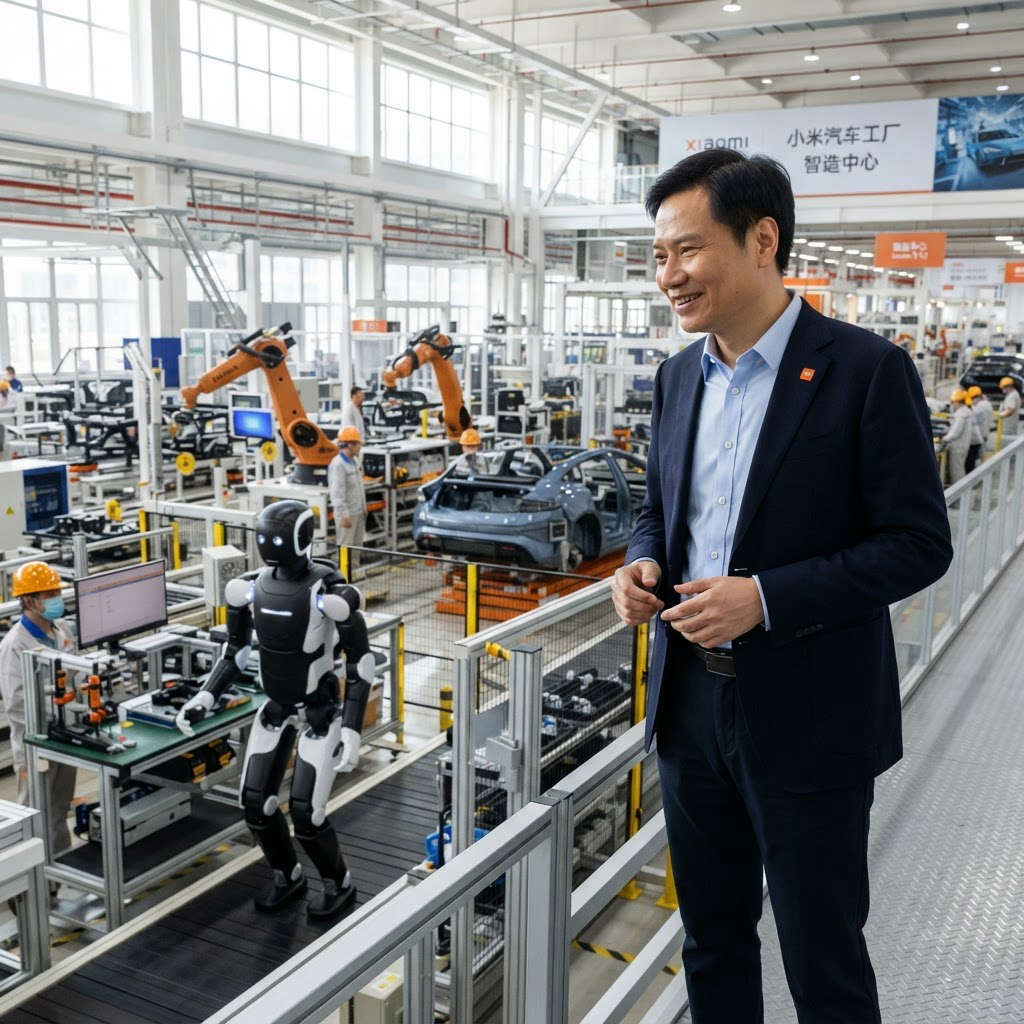
Xiaomi Group recently demonstrated a humanoid robot performing an eight-hour shift at a car factory's console side cover sorting station. The company reported that the robot autonomously corrected errors and coordinated with production systems during the shift. Additionally, Xiaomi has initiated a pilot program for its embodied base model at a youth apartment complex to test multi-room task management. These developments are part of the company's ongoing efforts to transition its robotics technology from laboratory testing to industrial and domestic applications.
Industrial Validation of Humanoid Systems
The recent demonstration by Xiaomi of a humanoid robot completing an eight-hour shift in a car factory marks a transition from experimental prototypes to functional industrial assets (Gasgoo, 2026). By successfully managing a console side cover sorting station, the robot proved its ability to handle repetitive, structured tasks while maintaining system-level coordination and autonomous error correction (Gasgoo, 2026). This performance is supported by the company's massive R&D investment, which reached 33.1 billion yuan in 2025, a 37.8% increase over the previous year (Gasgoo, 2026). The ability to operate for a full shift without human intervention is a critical benchmark for industrial viability, as it directly addresses the 'three D's'—dirty, dull, and dangerous work—that have historically defined industrial robotics (UMass Amherst, 2026).
Scaling Through Standardized Training Environments
To bridge the gap between laboratory performance and real-world reliability, Shenzhen has established a 6,000-square-meter 'robot school' designed to provide standardized training scenarios across six core fields, including 3C manufacturing and smart home applications (Borneo Post, 2026). This facility allows developers to collect on-site data and iterate on robot behavior in real-world conditions, significantly reducing the costs associated with commercialization (Borneo Post, 2026). The integration of these robots into real-world venues, such as sports stadiums and elderly care institutions, provides the necessary data to refine policies for contact-rich manipulation tasks (Borneo Post, 2026). However, technical barriers remain, particularly in ensuring robots can adapt to dynamic environments and fluctuating product lifecycles (Heriot-Watt University, 2026). Future research must focus on reinforcement learning and real-time sensor integration to improve the responsiveness of these systems in collaborative workspaces where human motion is unpredictable (Heriot-Watt University, 2026). The path to widespread adoption requires not only hardware improvements but also the development of robust, modular software architectures that allow for rapid reprogramming and minimal downtime in industrial settings (Siemens, 2026).
What It Will Take to Advance This
Long-term longitudinal studies are required to assess the reliability and safety of humanoid robots in uncontrolled, real-world environments over thousands of operational hours. Robots must achieve higher levels of adaptability to dynamic, unstructured environments, specifically improving their ability to handle novel objects and unpredictable human movements. Sustained, multi-year funding is necessary to support the high R&D costs associated with embodied intelligence, particularly for hardware-software integration and large-scale testing facilities. Standardized safety certifications and liability frameworks must be established to govern the deployment of autonomous humanoid robots in shared human-robot workspaces. The development of modular, standardized components—such as actuators and sensors—is essential to reduce per-unit costs and enable mass production of humanoid platforms.
Future Possibilities
Humanoid robots could provide 24/7 physical assistance to the aging population, performing tasks like patient lifting and medication delivery. This would reduce the burden on nursing staff and allow for more personalized care in home settings. The technology relies on the development of soft robotic structures that provide comfortable haptic feedback and gentle interaction. Researchers should prioritize the development of self-donning garments and soft robotic lifts to ensure safety in domestic environments.
- •Long term (5+ years)
- •Moderate confidence
Reference: Stanford's research into physical human-robot interaction and soft robotic structures is currently exploring these assistive applications (UMass Amherst, 2026).
Autonomous robots could be deployed for hazardous maintenance in defense-related infrastructure, such as AI data centers or remote military depots. This would minimize human exposure to dangerous environments and ensure operational continuity. The integration of defense-focused venture capital, such as Veteran Ventures Capital, suggests a growing interest in these dual-use capabilities. Future research should focus on hardening these systems against cybersecurity threats and ensuring reliable operation in contested environments.
- •Mid term (2-5 years)
- •Moderate confidence
Reference: Aformic's recent $6.95 million seed round, led by Veteran Ventures Capital, specifically targets AI data center maintenance (Unite.AI, 2026).
The widespread adoption of humanoid robots in manufacturing could significantly lower production costs and increase throughput, potentially reshoring industrial capacity to the U.S. By automating sorting and assembly, companies can achieve higher efficiency and reduce reliance on manual labor. This shift requires significant investment in workforce retraining to manage and maintain these autonomous fleets. Researchers should investigate the long-term economic impact of robot-human collaboration on wage structures and job displacement.
- •Mid term (2-5 years)
- •High confidence
Reference: Xiaomi's successful eight-hour factory shift demonstrates the potential for robots to meet full-day production requirements (Gasgoo, 2026).
Robotic disassembly could revolutionize the recycling of complex products like electric vehicle batteries, reducing waste and recovering valuable materials. By automating the handling of hazardous components, these systems improve worker safety and processing efficiency. The technology must be adaptable to unpredictable recycling demands and fluctuating product designs. Future research should focus on developing reinforcement learning models that can handle the variability inherent in disassembly tasks.
- •Long term (5+ years)
- •Low confidence
Reference: Recent studies indicate that semi-automated disassembly cells can reduce processing time by approximately 15% in battery recycling (Heriot-Watt University, 2026).
Embodied AI could manage complex household tasks, such as folding laundry or organizing multi-room environments, freeing up time for individuals. The current pilot runs in youth apartments demonstrate the feasibility of managing task chains spanning over 30 minutes. This requires robots to navigate and interact with unstructured home environments safely. Researchers should focus on improving the robustness of vision-language-action policies to handle the diversity of objects found in typical homes.
- •Long term (5+ years)
- •Moderate confidence
Reference: Xiaomi's pilot run at youth apartments involves managing over 50 distinct tasks across three rooms (Gasgoo, 2026).
The U.S. Department of Energy should expand its Advanced Manufacturing Office grants to specifically target the integration of embodied AI into existing assembly lines. By allocating $500 million over three years, the program would incentivize domestic manufacturers to pilot humanoid systems in high-risk or repetitive tasks. This funding would mirror the structure of the Grid SCALED program, focusing on hardware-software interoperability. The milestone for this investment would be the successful deployment of 1,000 units in U.S. automotive facilities by 2029.
- •Xiaomi's 105.5 billion yuan R&D investment demonstrates the scale required for competitive robotics development (Gasgoo, 2026).
- •The DOE's existing Grid SCALED program provides a proven model for bolstering domestic supply chain infrastructure (DOE, 2026).
Reference: Department of Energy, 'DOE Launches $237 Million Grid SCALED Program to Bolster Domestic Supply Chains', 2026
The National Institutes of Health should establish a collaborative framework with robotics developers to adapt industrial humanoid platforms for assistive care in hospitals. By leveraging the 'robot school' model seen in Shenzhen, the NIH could create standardized testing environments for patient lifting and mobility assistance. This initiative would require a $200 million appropriation to fund clinical trials assessing safety and efficacy in geriatric care settings. The goal is to achieve FDA clearance for the first general-purpose assistive humanoid by 2030.
- •Shenzhen's robot school model reduces data-collection costs by testing in real-world scenarios (Borneo Post, 2026).
- •Stanford's research into physical human-robot interaction provides the foundational design principles for safe assistive devices (UMass Amherst, 2026).
Reference: UMass Amherst, 'MIE Research Seminar: When Robots Care: Assistive Medical Robotics from Hospital to Home', 2026
The Department of Commerce should facilitate a public-private partnership to establish 'Robotics Manufacturing Hubs' that standardize core components for humanoid robots. By providing tax incentives for domestic production of actuators, sensors, and batteries, the U.S. can reduce reliance on foreign supply chains. This program would aim to lower the per-unit cost of humanoid robots by 40% within five years. The next milestone is the creation of a national certification standard for robot safety in collaborative workspaces.
- •Siemens' new ELV drive solution demonstrates the industry shift toward modular, integrated components for mobile robotics (Siemens, 2026).
- •Aformic's $6.95 million seed round highlights the growing venture interest in scaling autonomous industrial robotics (Unite.AI, 2026).
Reference: Siemens, 'Siemens launches new ELV drive solution for AGVs and mobile robotics', 2026
The National Institute of Standards and Technology (NIST) should lead the development of universal safety protocols for embodied AI in shared human-robot workspaces. This involves creating a regulatory sandbox where companies can test autonomous systems under real-world conditions without immediate liability for minor operational errors. By 2028, these standards would serve as the baseline for insurance and safety certifications across the U.S. manufacturing sector. This framework would be modeled after existing cybersecurity compliance standards for critical infrastructure.
- •The need for standardized robot training scenarios is critical for industrial deployment (Borneo Post, 2026).
- •The integration of autonomous systems into existing TIA Portal architectures shows the importance of standardized software interfaces (Siemens, 2026).
Reference: NIST, 'Framework for Cyber-Physical Systems', 2026
The Department of Labor should launch a national apprenticeship program focused on 'Robot Fleet Management' to train workers for the transition to automated manufacturing. This program would provide certification for technicians capable of maintaining, troubleshooting, and supervising humanoid robot fleets. By 2029, the initiative aims to train 50,000 workers, ensuring the workforce can adapt to the shift from manual assembly to robot-assisted production. The program would be funded through existing workforce development grants and partnerships with community colleges.
- •The shift toward autonomous robotics requires new skills in real-time sensor integration and reinforcement learning (Heriot-Watt University, 2026).
- •The success of robot schools in Shenzhen underscores the necessity of practical, on-site training for real-world deployment (Borneo Post, 2026).
Reference: Heriot-Watt University, 'Toward Sustainable Manufacturing: A Review on Innovations in Robotic Assembly and Disassembly', 2026
Sources
- Xiaomi Discloses Dual-Line Robotics Progress — Gasgoo
- Shenzhen pushes embodied intelligent robots into real-world use — Borneo Post Online
Topics
- Universe One
- Robotics & Automation
- could
- xiaomi
- industrial
- humanoid
- deployment
- lead
- widespread
- autonomous
- factory
- labor