Could the LM26 fusion milestone make grid-scale commercial fusion power a reality by 2035
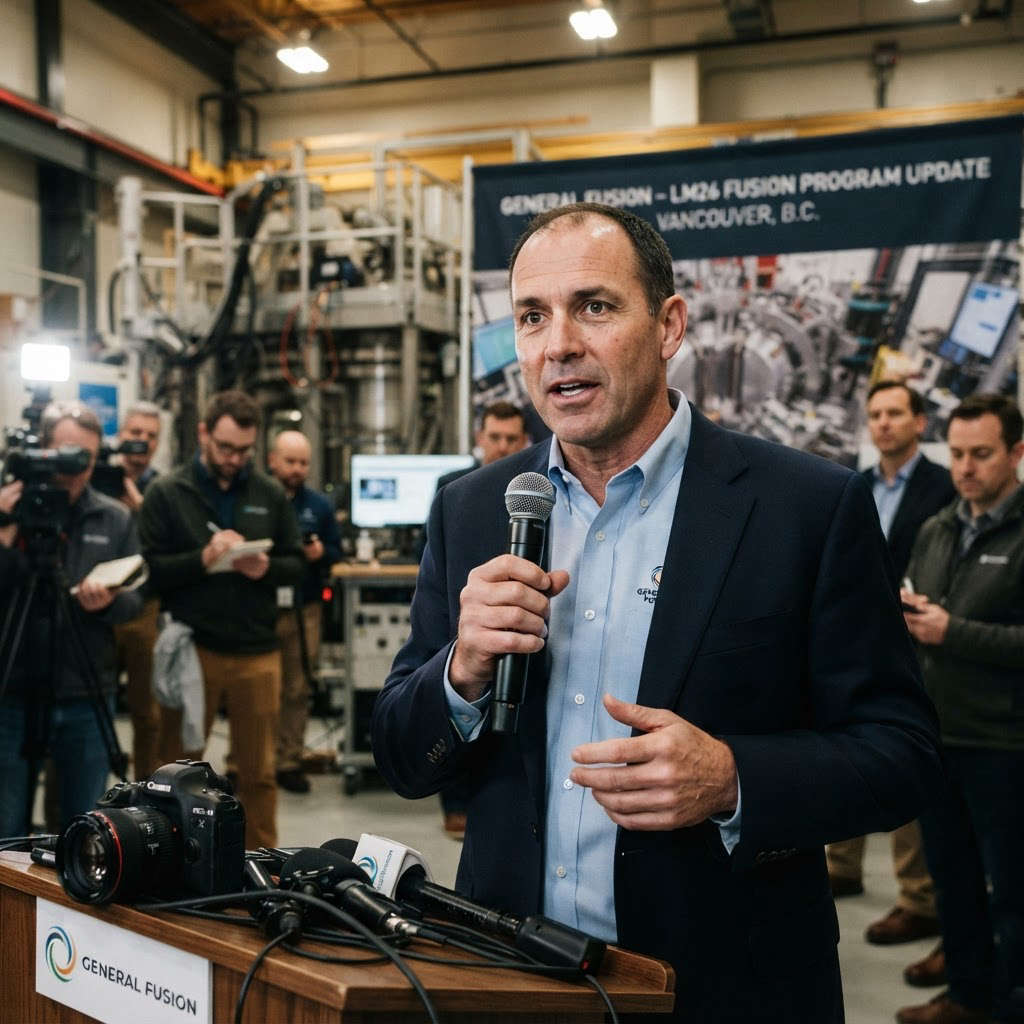
General Fusion has successfully achieved a plasma electron temperature of over 1 keV, equivalent to 12 million degrees Celsius, using its Lawson Machine 26 (LM26) demonstration device. This result, co-authored by the UK Atomic Energy Authority (UKAEA), marks the first major technical milestone in the company's phased program to validate Magnetized Target Fusion (MTF). The achievement confirms the effectiveness of the company's low-speed plasma compression approach, which utilizes a solid metal wall to compress plasma. The company is now proceeding with machine upgrades to target higher compression ratios and temperatures.
Validating Low-Speed Plasma Compression
The achievement of a 1 keV electron temperature in the Lawson Machine 26 (LM26) represents a critical validation of General Fusion's unique Magnetized Target Fusion (MTF) approach (General Fusion, '1 keV: A Milestone Achieved', 2026). Unlike traditional tokamak designs that rely on magnetic confinement alone, MTF uses a liquid metal liner to compress a magnetized plasma, a process that occurs at significantly lower speeds than inertial confinement fusion (UKAEA, 'UKAEA, General Fusion announce Magnetised Target Fusion milestone', 2026). The 1 keV result, which corresponds to approximately 12 million degrees Celsius, was independently measured in collaboration with the UK Atomic Energy Authority (UKAEA), providing a high degree of confidence in the experimental data (General Fusion, '1 keV: A Milestone Achieved', 2026). This result confirms that the compressional heating mechanism behaves as predicted by the company's physics models, which is essential for scaling the technology toward the 10 keV milestone (General Fusion, 'Business Update', 2026).
Path to Commercialization and Technical Hurdles
While the 1 keV milestone is a significant physics achievement, the path to a first-of-a-kind (FOAK) fusion plant by 2035 remains dependent on overcoming substantial engineering barriers (General Fusion, 'Path to Commercialization', 2026). The next phase of the LM26 program involves upgrading the machine to support higher plasma compression ratios, which will require more robust seals, valves, and heat exchange systems (General Fusion, 'LM26 Program', 2026). Furthermore, the company must demonstrate the ability to maintain plasma stability and energy confinement at 10 keV, the temperature required for meaningful fusion yields (General Fusion, 'Business Update', 2026). The collaboration with General Atomics to develop advanced diagnostic systems is a key step in this process, as measuring these extreme conditions is technically demanding (General Fusion, 'Business Update', 2026). The company's ability to successfully integrate these commercial-scale components into the LM26 demonstration will be the primary indicator of whether the technology can realistically transition from a laboratory experiment to a viable grid-scale power source (General Fusion, 'Path to Commercialization', 2026).
What It Will Take to Advance This
Researchers must demonstrate plasma stability and energy confinement at 10 keV, the next major milestone in the LM26 program. This requires achieving the Lawson Criterion, which combines temperature, density, and energy confinement time to prove net fusion energy potential. The company must successfully integrate commercial-scale heat exchange systems and tritium extraction processes into the LM26 machine. These systems are essential for converting fusion energy into usable electricity at a commercially relevant scale. Continued capital investment is required to fund the LM26 program through 2028. This includes securing additional funding for the development of high-performance diagnostic tools capable of measuring 100 million degrees Celsius. International regulators must establish standardized safety and licensing protocols for Magnetized Target Fusion (MTF) plants. This is necessary to provide a clear pathway for the deployment of first-of-a-kind (FOAK) fusion reactors. General Fusion must establish a robust supply chain for the specialized seals, valves, and liquid metal liners required for its MTF approach. Scaling these components to industrial levels is critical for the transition to commercial power production.
Future Possibilities
Not applicable to this energy technology.
- •Near term (0-2 years)
- •Low confidence
Reference: N/A
The successful development of commercial fusion energy would fundamentally alter national security by reducing reliance on volatile global energy markets and fossil fuel imports. By providing a stable, baseload power source, fusion could enhance the resilience of the U.S. electrical grid against both physical and cyber threats. This transition would require the deployment of modular fusion reactors, which could be integrated into existing grid infrastructure. A key research direction is the development of radiation-hardened materials for reactor containment, which would be necessary for long-term operational security.
- •Long term (5+ years)
- •Moderate confidence
Reference: General Fusion, 'Bringing Practical Fusion Energy to Market', 2026
Commercial fusion energy could lead to a significant reduction in the levelized cost of electricity (LCOE) by providing a carbon-free, high-density energy source. If General Fusion's MTF approach scales, it could replace aging coal and natural gas plants, creating a new multi-billion dollar industry in fusion reactor manufacturing and maintenance. The economic viability depends on the successful demonstration of the Lawson Criterion, which is the threshold for net energy production. Researchers should focus on optimizing the liquid metal liner cycle to minimize energy loss, which is a critical factor in the overall economic efficiency of the system.
- •Long term (5+ years)
- •Moderate confidence
Reference: General Fusion, 'Path to Commercialization', 2026
Fusion energy offers a path to near-zero carbon emissions for baseload power, significantly mitigating the environmental impact of electricity generation. Unlike fission, fusion produces minimal long-lived radioactive waste, simplifying the decommissioning process for future power plants. The deployment of these plants would require careful site selection and environmental impact assessments to ensure the safety of local ecosystems. A critical research direction is the development of efficient tritium breeding and extraction systems, which are necessary for a self-sustaining fuel cycle.
- •Long term (5+ years)
- •Moderate confidence
Reference: UKAEA, 'UKAEA, General Fusion announce Magnetised Target Fusion milestone', 2026
The maturation of MTF technology would drive innovation in advanced manufacturing, particularly in the production of high-precision, high-pressure components like seals and valves. This would create a specialized supply chain capable of supporting the extreme conditions required for fusion energy. The transition to commercial systems, expected as early as 2027, will require the development of new industrial standards for fusion-grade materials. Researchers should prioritize the testing of these materials under simulated fusion conditions to ensure long-term durability and reliability.
- •Mid term (2-5 years)
- •Moderate confidence
Reference: General Fusion, 'LM26 Program', 2026
The U.S. Department of Energy should integrate MTF-specific performance metrics into its fusion energy grant programs to accelerate the transition from 1 keV to 10 keV. By leveraging the $150 million in capital recently raised by General Fusion, federal matching grants could de-risk the development of the necessary heat exchange and tritium extraction systems. This funding would prioritize the procurement of high-performance diagnostic tools capable of measuring 100 million degrees Celsius. The next milestone is the successful demonstration of these diagnostics in the second phase of the LM26 program.
- •General Fusion secured $150 million in capital to fund LM26 milestones through 2028 (General Fusion, 'Business Update', 2026).
- •The company has established a framework with General Atomics to advance diagnostic capabilities for 10 keV measurements (General Fusion, 'Business Update', 2026).
Reference: General Fusion, 'General Fusion Provides First Public Company Business Update', 2026
Not applicable to this energy technology.
Reference: N/A
General Fusion must scale its liquid metal liner manufacturing to support the higher compression ratios required for the 10 keV milestone. This involves establishing a domestic supply chain for the specialized seals and valves identified in the LM26 commercialization roadmap. By 2027, the company aims to transition from plasma physics validation to the demonstration of balance-of-plant systems. This shift requires the integration of industrial-scale heat exchange components into the existing LM26 facility.
- •LM26 is designed to demonstrate commercial systems including seals, valves, and heat exchange systems (General Fusion, 'LM26 Program', 2026).
- •The company expects to transition to commercialization engineering as early as 2027 (General Fusion, 'Path to Commercialization', 2026).
Reference: General Fusion, 'Path to Commercialization', 2026
The UKAEA and international fusion regulators should establish standardized reporting protocols for MTF performance to ensure comparability with tokamak-based fusion results. This would involve creating a unified framework for the Lawson Criterion, which combines temperature, density, and energy confinement time. By standardizing these metrics, regulators can provide a clearer pathway for the licensing of first-of-a-kind (FOAK) fusion plants. This regulatory clarity is essential for attracting the private investment needed to reach the 2035 commercialization target.
- •The 1 keV result was measured in collaboration with the UKAEA, providing independent validation (General Fusion, '1 keV: A Milestone Achieved', 2026).
- •Achieving the Lawson Criterion is the primary goal for demonstrating net fusion energy (General Fusion, 'LM26 Program', 2026).
Reference: UK Atomic Energy Authority, 'UKAEA, General Fusion announce Magnetised Target Fusion milestone', 2026
Academic institutions should develop specialized training programs in Magnetized Target Fusion (MTF) to support the growing demand for engineers skilled in liquid metal plasma compression. This curriculum would focus on the intersection of high-performance computing, digital controls, and advanced materials science. By partnering with companies like General Fusion, universities can provide students with hands-on experience on large-scale demonstration machines. This pipeline is critical for staffing the FOAK plants expected to come online in the mid-2030s.
- •General Fusion has over 20 years of experience developing real-world test beds (General Fusion, 'Bringing Practical Fusion Energy to Market', 2026).
- •The company emphasizes the convergence of plasma physics, computing, and advanced manufacturing (General Fusion, 'Business Update', 2026).
Reference: General Fusion, 'Bringing Practical Fusion Energy to Market', 2026
Sources
- 1 keV: A Milestone Achieved, and Why It Matters — General Fusion
- UKAEA, General Fusion announce Magnetised Target Fusion milestone — UK Atomic Energy Authority
Topics
- Universe One
- Energy & Fusion
- could
- lm26
- fusion
- milestone
- make
- grid-scale
- commercial
- power
- reality