Climate & Earth Science
Could the NeuralGCM+ climate modeling initiative make high-resolution, long-term climate forecasting a reality
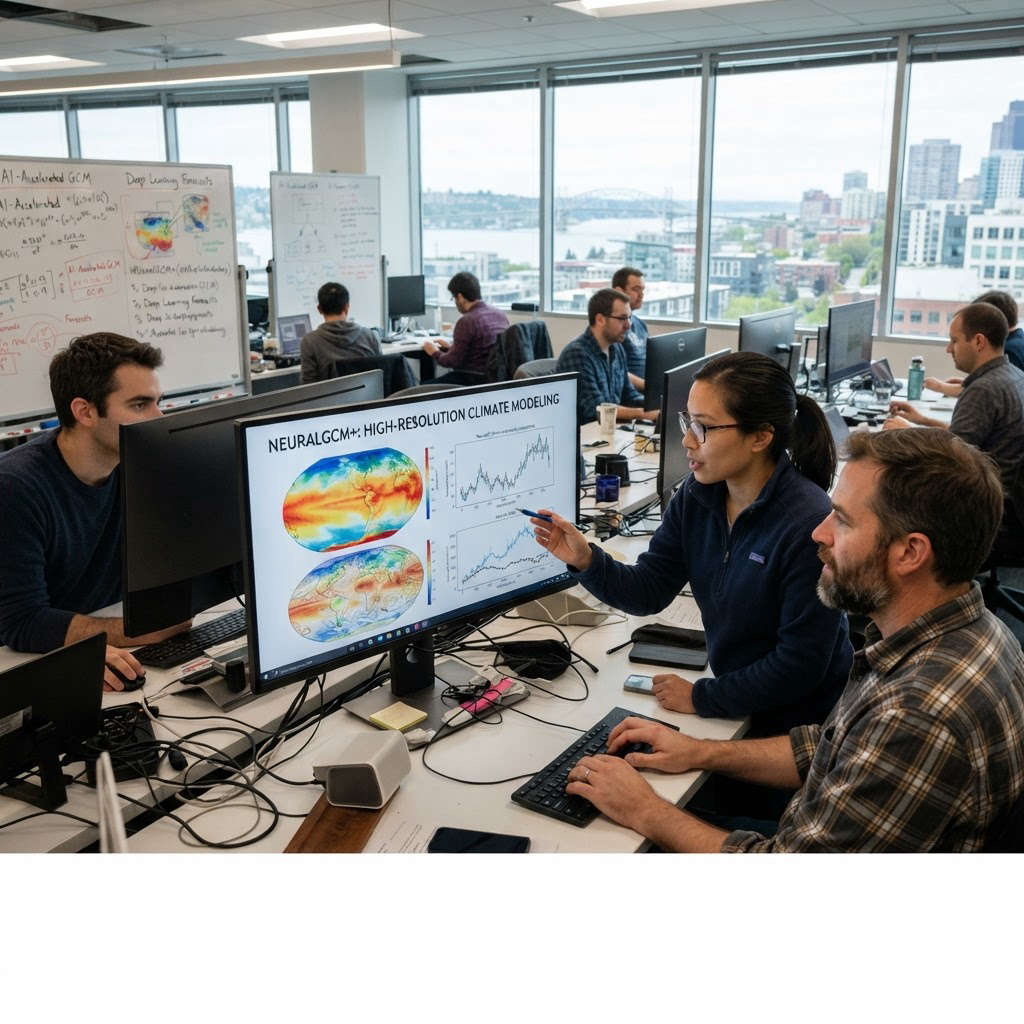
The Allen Institute for AI (Ai2) has launched a new climate modeling initiative, supported by multimillion-dollar funding from Google.org and technical expertise from Google Research. This project aims to develop NeuralGCM+, an open-source, AI-driven model designed to improve the speed and accuracy of long-term climate projections. By integrating atmospheric and oceanic data, the initiative seeks to provide a shared research platform that enables global communities to better prepare for decadal climate shifts.
Bridging the Gap Between Weather and Climate
Traditional climate modeling has historically struggled to balance the computational intensity of long-term projections with the high-resolution requirements needed for local adaptation planning (Ai2, 2026). While weather forecasting has seen rapid advancements in AI-driven speed, long-term climate projections—spanning decades—remain computationally expensive and often lack the transparency required for public policy (Ai2, 2026). The NeuralGCM+ initiative, a collaboration between the Allen Institute for AI (Ai2) and Google Research, aims to address this by developing an open-source platform that integrates atmospheric and oceanic dynamics (Ai2, 2026). By leveraging machine learning to calibrate these models, researchers hope to achieve the speed of AI forecasting with the physical rigor of traditional Earth system models (Ai2, 2026).
Scientific Limitations and Future Integration
Despite the promise of AI-enhanced modeling, significant technical hurdles remain. Current models often rely on stationary assumptions that may not hold as the climate enters unprecedented states, potentially leading to an underestimation of extreme events (Research Matters, 2026). Furthermore, the translation of these high-resolution forecasts into actionable policy remains a critical failure point; recent studies indicate that even when accurate early-warning systems exist, they often fail to trigger protective action due to a lack of trust or resources in vulnerable regions (University of Bristol, 2026). The success of NeuralGCM+ will depend not only on its computational accuracy but also on its ability to be integrated into existing international frameworks like the Coupled Model Intercomparison Project (CMIP7) (Science Media Centre, 2026). As the global community prepares for COP31, the focus is shifting toward ensuring that these advanced scientific tools are accessible to developing nations, which face the highest climate risks but often lack the infrastructure to utilize complex modeling data (UN News, 2026). Future research must prioritize the validation of these AI models against historical records while simultaneously developing the social science frameworks necessary to ensure that data-driven warnings lead to effective, life-saving interventions (University of Bristol, 2026).
What It Will Take to Advance This
Researchers must conduct extensive validation studies comparing NeuralGCM+ outputs against historical climate data and existing CMIP6/CMIP7 models to ensure physical consistency. This requires a standardized benchmark dataset that accounts for non-stationary climate relationships. The model must overcome the 'stationary copula' limitation, where current models assume static relationships between variables like heatwave intensity and duration. Developing dynamic, time-varying copula functions is essential for capturing the non-linear nature of future climate extremes. Sustained, multi-year funding is required to maintain the open-source platform and support the interdisciplinary team of climate scientists and AI engineers. A commitment of at least $100 million over five years is necessary to scale the project to global utility. International standards bodies must establish a certification process for AI-generated climate projections to ensure they meet the rigorous requirements of the IPCC and other global climate governance frameworks. The project requires the development of a robust, cloud-based infrastructure capable of processing petabytes of climate data and providing high-resolution outputs to users worldwide. This infrastructure must be interoperable with existing national meteorological services.
Future Possibilities
Improved climate modeling will allow public health officials to predict heat-related mortality spikes with greater lead time, enabling the pre-positioning of medical resources. By integrating high-resolution temperature projections into local health systems, cities can implement targeted cooling interventions for vulnerable populations. This shift from reactive to anticipatory health management could save millions of lives annually. Researchers should next investigate the correlation between AI-modeled heatwave duration and specific cardiovascular health outcomes to refine these early-warning systems.
- •Mid term (2-5 years)
- •Moderate confidence
Reference: WHO reports that six prioritized climate-health interventions could save 1.6 million lives annually (WHO, 2026).
Enhanced climate projections will provide the Department of Defense with more accurate data on regional instability caused by resource scarcity, such as water and food shortages. This allows for better strategic planning regarding humanitarian aid, border security, and regional alliances in climate-vulnerable areas. By anticipating climate-driven migration patterns, the U.S. can proactively engage in diplomatic efforts to stabilize regions before crises escalate. Future research should focus on mapping the intersection of AI-modeled climate stress and existing geopolitical conflict datasets.
- •Long term (5+ years)
- •Moderate confidence
Reference: Research indicates that climate-related events affected 13 million people in Africa in 2025, highlighting the link between extreme weather and population displacement (University of Bristol, 2026).
The financial sector will be able to more accurately price climate risk into insurance premiums and infrastructure investments, reducing the likelihood of sudden market shocks. By utilizing high-resolution projections, companies can better assess the long-term viability of assets in fire-prone or flood-prone regions. This transparency will likely unlock billions in capital for climate-resilient infrastructure projects. Researchers should develop standardized AI-driven risk assessment protocols that financial institutions can adopt to ensure consistency in climate-related financial disclosures.
- •Mid term (2-5 years)
- •High confidence
Reference: A new report suggests that regulatory changes could unlock €9.3 billion in circular economy investments, demonstrating the impact of data-driven policy (Sustainability Online, 2026).
NeuralGCM+ will enable more precise monitoring of carbon sinks and vegetation stress, allowing for more effective conservation strategies. By understanding how different ecosystems respond to specific warming thresholds, policymakers can prioritize the protection of areas that provide the greatest carbon sequestration benefits. This will be critical for meeting international climate targets and preventing the overshoot of the 1.5 °C threshold. Future studies should integrate satellite-based vegetation data with AI climate models to create real-time carbon sequestration maps.
- •Long term (5+ years)
- •Low confidence
Reference: Recent research shows that zero emissions commitment depends on the warming level at which emissions cease, underscoring the need for precise modeling (Nature Climate Change, 2026).
Citizens will benefit from more reliable, localized weather and climate information, enabling better personal decision-making regarding property, travel, and energy consumption. As these models become more accessible, they could be integrated into consumer-facing applications that provide personalized climate risk assessments for homeowners. This will empower individuals to take proactive measures, such as retrofitting homes for extreme weather. Researchers should focus on developing user-friendly interfaces that translate complex climate data into actionable advice for the general public.
- •Long term (5+ years)
- •Moderate confidence
Reference: The need for translating forecasts into protective action is a major priority for climate-vulnerable communities (University of Bristol, 2026).
The Department of Energy (DOE) should establish a dedicated grant line under the Office of Science to support the integration of NeuralGCM+ into national climate assessment workflows. By providing $50 million over three years, the DOE can ensure that open-source AI models are validated against existing Earth system models like the Energy Exascale Earth System Model (E3SM). This funding would accelerate the transition from experimental code to a standardized tool for federal climate risk assessment.
- •Ai2's collaboration with Google Research provides a technical foundation for open-source climate AI (Ai2, 2026).
- •DOE research has already demonstrated that machine learning improves groundwater representation in Earth system models (Newswise, 2026).
Reference: Department of Energy, Office of Science, 'Machine Learning Helps Improve How Earth System Models Represent Groundwater', 2026
National laboratories should build a centralized, cloud-based infrastructure to host NeuralGCM+ outputs, allowing state and local governments to access high-resolution climate projections for urban planning. This infrastructure would replace fragmented, proprietary modeling efforts with a unified, transparent platform. By 2028, this would enable cities to simulate the impact of specific warming thresholds on local heatwaves and water security.
- •Current climate modeling lacks the speed and accessibility needed for local community planning (Ai2, 2026).
- •New research highlights that urban areas require specific, high-resolution modeling to prepare for heatwave intensity (Research Matters, 2026).
Reference: Research Matters, 'New climate study warns Indian cities will face harsher and longer heatwaves under global warming', 2026
The U.S. should lead an international consortium at COP31 to adopt NeuralGCM+ as a standard for the Coupled Model Intercomparison Project (CMIP7) fast-track. By sharing the open-source code with developing nations, the U.S. can help bridge the gap in climate adaptation finance and technical capability. This collaboration would ensure that global climate policy is underpinned by consistent, high-fidelity scientific data.
- •The World Climate Research Programme is currently seeking to update CMIP7 projections for new scenarios (Science Media Centre, 2026).
- •Developing nations face significantly higher costs for renewable energy and climate adaptation, necessitating better data tools (UN News, 2026).
Reference: UN News, 'COP31 explained: What’s at stake at this year’s UN climate summit?', 2026
The National Oceanic and Atmospheric Administration (NOAA) should develop a certification framework for AI-based climate models to ensure they meet federal standards for accuracy and transparency. This framework would define the benchmarks for 'reliable future projections' as identified by the Ai2 initiative. Establishing these standards would allow policymakers to confidently integrate AI-generated climate risk assessments into federal insurance and disaster relief programs.
- •Demonstrating reliable future projections remains a central research task for climate modeling labs (Ai2, 2026).
- •The IPCC relies on CMIP7 projections for its assessment reports, which guide global climate-resilient development (Science Media Centre, 2026).
Reference: Ai2, 'Ai2 and Google collaborate on a new generation of climate models', 2026
The National Science Foundation (NSF) should launch a fellowship program to train the next generation of climate scientists in hybrid AI-physics modeling. This program would focus on the technical skills required to maintain and improve open-source models like NeuralGCM+. By creating a pipeline of experts, the U.S. can maintain its leadership in climate science while addressing the current shortage of researchers capable of bridging AI and Earth system science.
- •Funding cuts are currently jeopardizing research jobs and institutions, threatening the future of climate science (Science Media Centre, 2026).
- •Ai2 is actively expanding its Climate Modeling team to support the development of NeuralGCM+ (Ai2, 2026).
Reference: Science Media Centre, 'What can we expect from COP31? - Expert Reaction', 2026
Sources
- What can we expect from COP31? - Expert Reaction — Science Media Centre
- The Sustainability Brief – 5 November 2026 — Sustainability Online
Topics
- Universe One
- Climate & Earth Science
- could
- neuralgcm
- climate
- modeling
- initiative
- make
- high-resolution
- long-term
- forecasting