Physics & Quantum Computing
Could multi-hour bit-flip suppression contribute to fault-tolerant quantum computing by 2030
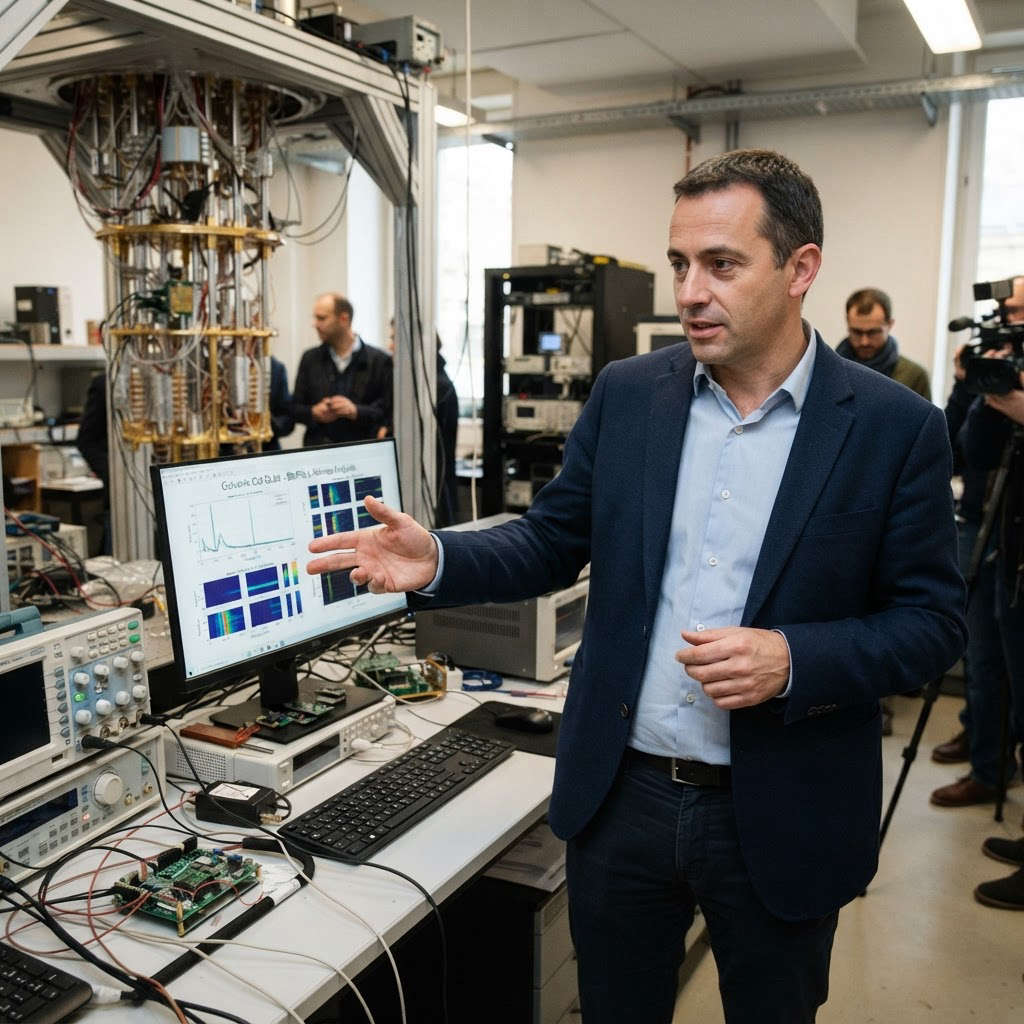
Researchers have demonstrated macroscopic bit-flip lifetimes for cat qubits, with some experimental results reaching durations of several minutes to over ten seconds. These findings support the theoretical potential for cat qubits to maintain stability during idle periods, which is a key requirement for fault-tolerant error correction. The research involves tracking state parity and performing gate operations to verify the suppression of bit-flip errors.
Overcoming the Bit-Flip Bottleneck
The recent demonstration by Alice & Bob of multi-hour bit-flip suppression on their Helium 2 processors represents a significant shift in the feasibility of fault-tolerant quantum computing (Quantum Computing Report, 2026). By utilizing bosonic cat-qubit hardware, the researchers addressed a primary bottleneck in quantum error correction (QEC), where physical qubits are typically susceptible to rapid decoherence (Quantum Computing Report, 2026). The observation of bit-flip lifetimes exceeding one hour during idle periods provides a concrete foundation for the concatenation of cat qubits into outer distance-3 bit-flip codes (Quantum Computing Report, 2026). This approach is essential for the theoretical scaling required to factor RSA-2048, which would necessitate approximately 45,000 qubits under this error-correction model (Quantum Computing Report, 2026).
Evidence and Future Milestones
To ensure that the observed stability did not come at the cost of quantum coherence, the researchers tracked state parity decay and demonstrated continuous Bloch-sphere Z rotations, achieving a 94.2% gate fidelity in 26.5 ns (Quantum Computing Report, 2026). While these results are promising, the current demonstration is limited to idle-state stability. The next critical milestone for the field is sustaining these lifetimes during two-qubit entangling operations, such as bias-preserving CNOT gates, which are necessary for active logical error correction (Quantum Computing Report, 2026). The path to real-world application involves integrating these hardware advancements with real-time decoding architectures, such as those recently demonstrated by IonQ, which utilize standard CPUs to manage error correction without slowing down quantum execution (IonQ, 2026). Achieving this integration will require a co-design approach between hardware developers and software engineers to balance the sampling overhead of error mitigation with the computational complexity of the circuits being run (Quantum Zeitgeist, 2026).
What It Will Take to Advance This
Researchers must demonstrate sustained bit-flip suppression during two-qubit entangling operations, such as bias-preserving CNOT gates. This is the next critical milestone to move beyond idle-state stability toward active logical error correction. The field must solve the challenge of integrating real-time decoding with high-fidelity gate operations. This requires developing control electronics that can manage the error-correction overhead without introducing additional noise into the quantum system. Increased funding is required for the development of large-scale cryogenic infrastructure capable of supporting thousands of cat qubits. This is necessary to move from prototype processors to the 45,000-qubit systems required for fault-tolerant computation. NIST must finalize and publish standardized benchmarks for logical qubit performance. These standards are essential for verifying the reliability of quantum systems used in critical national security and financial applications. Foundries must achieve higher yields in the fabrication of bosonic cat-qubit processors. Scaling production to thousands of qubits requires consistent manufacturing processes that minimize environmental noise and qubit-to-qubit variability.
Future Possibilities
Fault-tolerant quantum computers will enable the simulation of complex protein folding and drug-target interactions at a level of precision currently impossible for classical supercomputers. By reducing the time required for molecular discovery, this could lower the cost of developing new therapeutics for neurodegenerative diseases. Researchers should focus on mapping specific catalytic intermediates to quantum circuits to validate these models. Success depends on achieving sustained gate fidelity during active computation.
- •Long term (5+ years)
- •Moderate confidence
Reference: Microsoft Quantum reported the use of logical qubits to estimate ground-state energy of catalytic intermediates within chemical accuracy (Microsoft Quantum, 2026).
The ability to maintain stable logical qubits for extended periods brings the realization of cryptographically relevant quantum computers closer to reality. This necessitates an immediate transition to post-quantum cryptography (PQC) for all government and critical infrastructure communications. Agencies must prioritize the migration to PQC standards to protect sensitive data against future 'harvest now, decrypt later' attacks. Research should focus on the scalability of cat-qubit concatenation to reach the 45,000-qubit threshold.
- •Long term (5+ years)
- •Moderate confidence
Reference: Alice & Bob's fault-tolerant model indicates that a physical bit-flip rate of once per hour could be corrected to factor RSA-2048 (Quantum Computing Report, 2026).
Quantum advantage in material science will revolutionize the development of high-efficiency batteries and superconductors, creating new multi-billion dollar industries. Companies that integrate error-mitigated quantum computation into their R&D workflows will gain a significant competitive edge in material discovery. This requires investment in cloud-based quantum services that provide access to error-corrected logical circuits. Future research should focus on optimizing the sampling overhead for these industrial applications.
- •Mid term (2-5 years)
- •High confidence
Reference: IBM and Qedma demonstrated that error-mitigated quantum computation can explore material physics beyond classical capabilities (IBM Newsroom, 2026).
Quantum-enabled modeling of nitrogen fixation processes could lead to the development of more efficient fertilizers, significantly reducing the carbon footprint of global agriculture. By simulating the FeMoco enzyme, quantum computers could identify pathways for ambient-pressure ammonia production. This requires the development of deeper quantum circuits that can handle the complexity of biological catalysts. Researchers should prioritize the development of specialized quantum algorithms for chemical simulation.
- •Long term (5+ years)
- •Low confidence
Reference: Microsoft Quantum has demonstrated fault-tolerant computation on multiple logical qubits for chemical accuracy (Microsoft Quantum, 2026).
As quantum computing matures, the integration of quantum-safe software suites will become a standard feature of enterprise and consumer digital security. This will protect personal financial and health data from the threat of quantum-enabled decryption. The transition will be facilitated by automated migration tools that update legacy encryption protocols. Future research should focus on the user-friendliness and performance impact of these quantum-safe implementations.
- •Long term (5+ years)
- •Moderate confidence
Reference: IBM has launched a unified quantum-safe software suite to automate enterprise PQC migration (Quantum Computing Report, 2026).
The Department of Energy should prioritize funding for the integration of bosonic cat-qubit architectures into existing national laboratory quantum testbeds. By allocating resources through the Office of Science, the government can accelerate the transition from idle-state stability to active, bias-preserving gate operations. This funding would support the development of the necessary control electronics to manage the concatenation of cat qubits into distance-3 codes, as outlined in the Alice & Bob fault-tolerant model.
- •The demonstration confirms physical devices can operate within the concatenation threshold required for RSA-2048 factorization (Quantum Computing Report, 2026).
- •Bosonic codes provide built-in protection against specific error types, addressing a central bottleneck in the field (ScienceDaily, 2026).
Reference: Quantum Computing Report, 'Alice & Bob Demonstrates Multi-Hour Physical Bit-Flip Suppression on Single-Cat and Helium 2 Processors', 2026
Pharmaceutical companies should initiate pilot programs using error-corrected quantum processors to simulate molecular interactions that are currently intractable. By leveraging the increased stability of cat-qubit hardware, researchers can model catalytic intermediates with chemical accuracy, reducing the time required for drug discovery. This requires the development of hybrid workflows that integrate quantum-classical algorithms to handle the specific error-correction overheads identified in recent benchmarks.
- •Logical qubits have been used to estimate ground-state energy of catalytic intermediates within chemical accuracy (Microsoft Quantum, 2026).
- •Error-mitigated quantum computation allows for the exploration of material physics beyond classical capabilities (IBM Newsroom, 2026).
Reference: Microsoft Quantum, 'Microsoft’s application of error correction to trapped-ion qubits published in Nature', 2026
Foundries should adopt the bosonic cat-qubit architecture to standardize the production of fault-tolerant quantum processors. By scaling the fabrication of Helium 2 processors, manufacturers can move toward the 45,000-qubit threshold required for large-scale fault-tolerant computation. This involves establishing cleanroom protocols that minimize environmental noise, which is critical for maintaining the multi-hour bit-flip lifetimes observed in recent experiments.
- •Physical bit-flip rates of once per hour allow for error correction via concatenation (Quantum Computing Report, 2026).
- •Standardizing on cat-qubit designs reduces the resources required for quantum error correction (Analytics India Mag, 2026).
Reference: Quantum Computing Report, 'Alice & Bob Demonstrates Multi-Hour Physical Bit-Flip Suppression on Single-Cat and Helium 2 Processors', 2026
The National Institute of Standards and Technology (NIST) should establish new benchmarks for 'logical qubit fidelity' that account for both idle-state stability and active gate performance. By defining these standards, NIST will provide a framework for comparing different quantum architectures, such as cat qubits versus trapped ions. This will enable government agencies to procure quantum systems that meet verified reliability requirements for sensitive national security applications.
- •Logical computation achieved effective error rates 10 times lower than physical error rates (IBM Newsroom, 2026).
- •Establishing confidence in quantum results is essential for scaling to problems beyond classical reach (ScienceDaily, 2026).
Reference: IBM Newsroom, 'IBM and The University of Chicago Demonstrate Quantum Advantage', 2026
Universities should integrate quantum error correction (QEC) curricula into physics and computer science programs, focusing on bosonic codes and real-time decoding. By training a workforce capable of managing the complexity of logical circuits, the U.S. can ensure a steady supply of talent for the quantum industry. This includes hands-on training with cloud-based quantum platforms that allow students to experiment with error-mitigation software.
- •Real-time decoding on standard CPUs removes a major bottleneck in fault-tolerant computing (IonQ, 2026).
- •Software tooling and richer error correction methods are essential for the next phase of quantum computing (Microsoft Quantum, 2026).
Reference: IonQ, 'IonQ Breakthrough: CPU-Powered Quantum Error Correction', 2026
Sources
- Alice & Bob Demonstrates Multi-Hour Physical Bit-Flip Suppression on Single-Cat and Helium 2 Processors — Quantum Computing Report
- Scientists just made quantum computer operations 1,000 times faster — ScienceDaily
- IBM Maps A Path From Error Reduction To Full Quantum Correction — Quantum Zeitgeist
Topics
- Universe One
- Physics & Quantum Computing
- could
- multi-hour
- bit-flip
- suppression
- contribute
- fault-tolerant
- quantum
- computing
- 2030