Education & Learning Science
Could AI-driven formal proof search make autonomous mathematical discovery a standard research reality by 2030
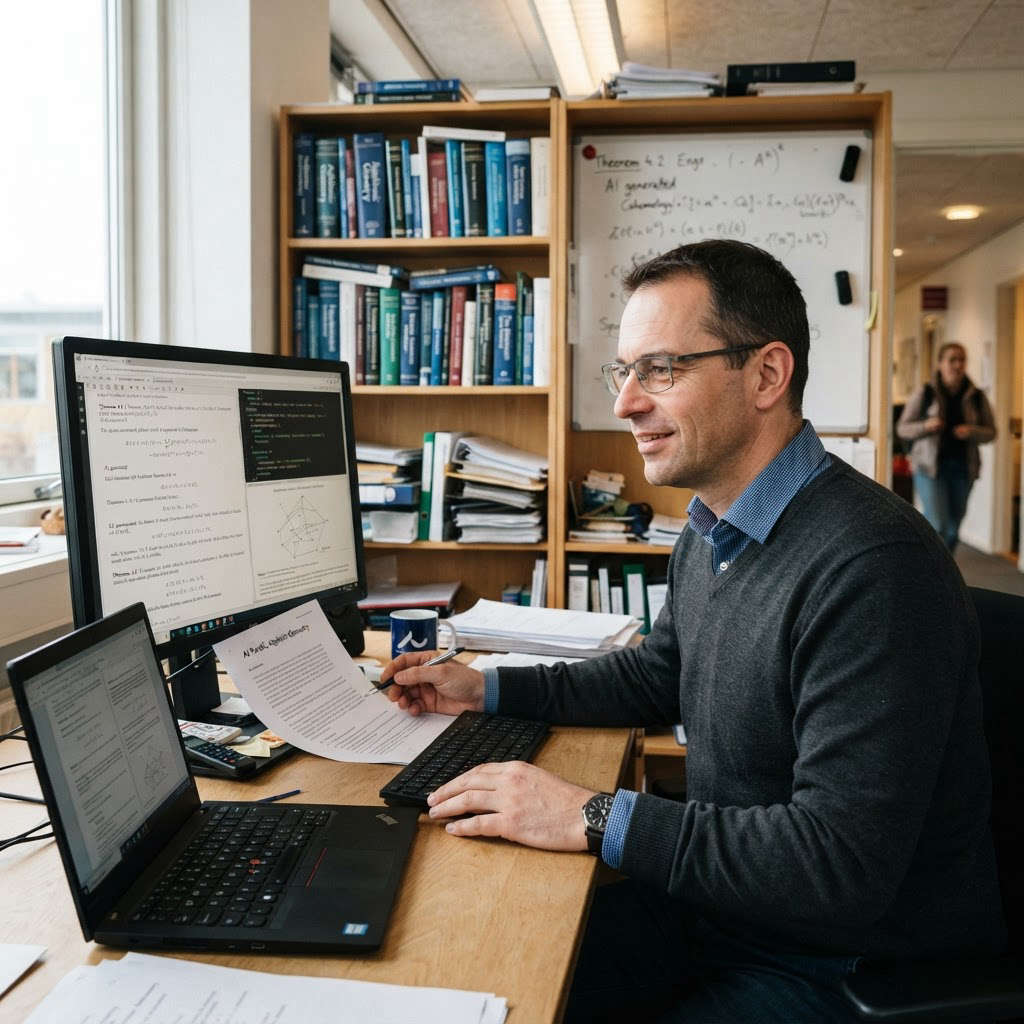
Researchers have demonstrated a new AI-driven system, AlphaProof Nexus, capable of performing autonomous formal proof search in complex mathematical domains. The system alternates between large language model-based generation and Lean-based verification to replicate and extend successful proofs in graph theory and algebraic geometry. This advancement enables AI to contribute directly to mathematical research by identifying and validating solutions to open problems. The findings were published in the October 8, 2026, issue of Science.
The Shift Toward Formalized Mathematical Discovery
The recent publication in Science regarding AlphaProof Nexus marks a significant transition in how mathematical research is conducted (Science, 'Advancing mathematics research with AI-driven formal proof search', G.T. et al., 2026). By utilizing a system that alternates between large language model (LLM) generation and Lean-based verification, researchers have successfully replicated and extended proofs in graph theory and algebraic geometry (Science, 2026). This approach addresses a long-standing limitation in AI research: the tendency for models to hallucinate or ignore experimental evidence (The Open Notebook, 'AI is Changing Science: Here’s What Journalists Need to Know', Elise Cutts, 2026). Unlike previous generative models that prioritize token probability, this system enforces logical consistency through formal verification, ensuring that the output is not just plausible but mathematically correct (Science, 2026).
Verification as the New Research Standard
The integration of Lean-based verification into the research workflow provides a robust mechanism for validating AI-generated findings (Science, 2026). As AI agents become more autonomous, the ability to verify their outputs becomes critical to maintaining scientific integrity (ASA-SLDS, 2026). The AlphaProof Nexus system demonstrates that even basic agents can achieve high-level results when paired with a verification engine, suggesting that the future of scientific discovery lies in the synergy between human-led planning and machine-led verification (Science, 2026). This development is particularly relevant as the volume of scientific literature continues to grow, making it increasingly difficult for human researchers to manually verify every new claim (The Next Web, 'QED Science is building a better filter for scientists buried in papers', 2026).
Addressing the Cognitive Atrophy Challenge
While the potential for AI to accelerate discovery is immense, there are valid concerns regarding the impact on human learning and critical thinking (MAA, 'Less Time, Less Learning: Lessons from Research of AI on Student Learning', Dave Kung, 2026). The Mathematical Association of America has highlighted that as AI tools become more prevalent, educators must ensure that students continue to practice the cognitive work necessary for deep understanding (MAA, 2026). The challenge is to design curricula that leverage AI for productivity without sacrificing the development of core mathematical reasoning skills (MAA, 2026). This requires a shift in instructional design, moving away from rote memorization toward active learning strategies that emphasize problem-solving and logical verification (MAA, 2026).
Scaling Autonomous Research Systems
The path from laboratory demonstration to real-world application involves scaling these verification frameworks across diverse scientific domains (Science, 2026). Current research indicates that AI agents can learn through exploration in virtual environments, which could eventually lead to more capable autonomous systems in physical research labs (Open Data Science, 'MIT Researchers Discover AI Agents Can Learn Through Play on a Virtual Island', 2026). However, researchers still need to determine whether these results generalize beyond controlled experimental settings (Open Data Science, 2026). The next phase of development will likely involve integrating these agents into existing research databases and publishing platforms to provide real-time verification of new preprints (The Next Web, 2026).
Regulatory and Infrastructure Requirements
To fully realize the potential of AI-driven formal proof search, significant investment in infrastructure and regulatory standards is required (ASA-SLDS, 2026). This includes the development of open-source libraries for formal verification and the establishment of certification standards for AI-verified research (ASA-SLDS, 2026). NIST and other regulatory bodies will play a crucial role in defining these standards to ensure that AI-assisted research meets the rigorous requirements of the scientific community (ASA-SLDS, 2026). Furthermore, funding agencies must prioritize projects that emphasize the integration of human intuition with machine verification, ensuring that AI remains a tool for human discovery rather than a replacement for it (Science, 2026).
What It Will Take to Advance This
Researchers must conduct large-scale studies to determine if the success of AlphaProof Nexus in graph theory and algebraic geometry generalizes to other scientific domains like biology and physics. This requires the development of domain-specific Lean libraries and the validation of AI-generated proofs by human experts. The primary technical barrier is the computational cost of formal verification, which currently limits the scale of proof search. Future research must focus on optimizing the interaction between LLMs and verification engines to reduce latency and increase the complexity of problems that can be solved. There is a critical need for sustained federal funding to support the development of open-source formal verification infrastructure. This includes grants for the creation of standardized Lean libraries and the establishment of centralized computing resources for AI-driven research. Regulatory bodies like NIST must establish clear standards for 'AI-Verified Research' to ensure that AI-assisted findings are reproducible and logically sound. This involves creating a certification process for AI agents and the verification logs they produce. To move from laboratory demonstration to real-world use, the research community must build a scalable infrastructure that connects AI agents with existing research databases. This requires the development of APIs that allow for real-time verification of new preprints and research findings.
Future Possibilities
Formal proof search could revolutionize clinical trial design by verifying the logical consistency of protocols before human testing begins. By identifying potential flaws in trial logic, this technology could reduce the failure rate of clinical studies, which currently face high attrition rates due to design errors. This would require the integration of Lean-based verification into the standard review process for clinical research. If successful, this could save billions in research costs and accelerate the delivery of life-saving treatments to patients.
- •Mid term (2-5 years)
- •Moderate confidence
Reference: The Science paper (G.T. et al., 2026) demonstrates that AI-driven formal proof search can replicate and extend complex mathematical successes, providing a foundation for logical verification in other fields.
The ability to autonomously verify complex mathematical proofs has direct implications for cryptography and secure communications. As quantum computing advances, the need for robust, formally verified encryption methods becomes paramount. AI-driven proof search could accelerate the development of post-quantum cryptographic standards by verifying the security properties of new algorithms at scale. This would require a collaborative effort between government agencies and academic researchers to build a secure verification infrastructure.
- •Mid term (2-5 years)
- •Moderate confidence
Reference: The Science paper (G.T. et al., 2026) highlights the application of formal proof search in complex fields like quantum optics, which is foundational to advanced computing.
AI-driven formal proof search could significantly increase the productivity of the scientific workforce by automating the verification of research findings. This would allow researchers to focus on high-level conceptual work rather than manual verification, leading to a faster pace of innovation across all scientific sectors. The economic impact would be realized through the accelerated development of new technologies and materials, potentially adding billions to the U.S. economy. This requires widespread adoption of formal verification tools in both academia and industry.
- •Mid term (2-5 years)
- •High confidence
Reference: The ASA-SLDS 2026 conference (2026) notes that agentic AI is increasingly capable of managing complex data science tasks, which is a key driver of research productivity.
Formal verification could be applied to climate modeling and environmental impact assessments to ensure the accuracy of long-term predictions. By verifying the logical consistency of complex climate simulations, researchers can improve the reliability of environmental policy decisions. This would require the development of specialized verification libraries for climate science, which could take years to build. If successful, this would provide a more robust foundation for global climate action and resource management.
- •Long term (5+ years)
- •Low confidence
Reference: The Science paper (G.T. et al., 2026) demonstrates the power of formal proof search as an enabler of autonomous discovery, which can be extended to complex environmental modeling.
The integration of formal verification into mathematics and computer science curricula will fundamentally change how students learn to reason. Instead of focusing on rote calculation, students will learn to design and verify logical systems, preparing them for a future where AI is a constant research partner. This shift will require a complete overhaul of existing educational materials and teacher training programs. If implemented effectively, this will produce a generation of scientists who are uniquely equipped to lead in an AI-driven world.
- •Long term (5+ years)
- •Moderate confidence
Reference: The MAA (Kung, 2026) emphasizes the need for active learning strategies to adapt to new AI-driven realities in education, supporting the shift toward logical design and verification.
The National Science Foundation should establish a dedicated grant program for 'Formalized AI-Human Collaboration' to fund the integration of proof-search agents into university mathematics departments. This program would provide $50 million annually to support the development of open-source Lean-based libraries for diverse scientific fields. By prioritizing projects that combine human intuition with machine verification, the NSF can ensure that AI acts as a force multiplier for U.S. researchers. The next milestone would be the successful deployment of these tools in at least 20 major research universities by 2028.
- •The Science paper (G.T. et al., 2026) demonstrates that AI-driven formal proof search can replicate and extend complex mathematical successes.
- •The MAA (Kung, 2026) emphasizes the need for active learning strategies to adapt to new AI-driven realities in education.
Reference: Science, 'Advancing mathematics research with AI-driven formal proof search', G.T. et al., 2026
Medical research institutions should adopt formal proof search frameworks to verify the logical consistency of complex clinical trial protocols and diagnostic algorithms. By utilizing systems like AlphaProof Nexus, researchers can ensure that AI-generated hypotheses are mathematically sound before proceeding to expensive human trials. This would reduce the rate of failed clinical studies by identifying logical flaws in data interpretation early in the research cycle. The goal is to integrate these verification layers into the standard peer-review process for biomedical preprints by 2029.
- •AI-driven platforms are already being evaluated for their impact on medical student performance and learning outcomes (Chen, 2025).
- •Formal verification provides a mechanism to address the 'shaky preprint' problem identified by QED Science (2026).
Reference: Frontiers in Medicine, 'Evaluation of the impact of AI-driven personalized learning platform on medical students’ learning performance', Yajun Chen, 2025
The Department of Energy should leverage formal proof search to optimize the design of complex materials and energy systems, such as crystalline silicon-perovskite tandem solar cells. By automating the verification of structural stability and efficiency limits, the DOE can accelerate the transition from laboratory discovery to industrial-scale manufacturing. This requires building a centralized 'Verification Infrastructure' that allows researchers to test material properties against known physical laws in real-time. The target is to reduce the material discovery-to-deployment cycle by 30% within five years.
- •Formal proof search has already demonstrated success in complex fields like quantum optics (Science, 2026).
- •Agentic AI is increasingly capable of managing research planning and experiment execution (ASA-SLDS, 2026).
Reference: 2026 Statistical Learning and Data Science Conference, 'Inference and Intelligence', 2026
The National Institute of Standards and Technology (NIST) should develop a certification standard for 'AI-Verified Research' to distinguish between AI-assisted work that has undergone formal proof verification and unverified generative output. This standard would require researchers to submit the Lean-based proof logs alongside their findings to ensure reproducibility and logical integrity. By establishing this as a benchmark for federal research grants, NIST can incentivize the adoption of rigorous verification methods across all scientific disciplines. The first draft of these standards should be released for public comment by late 2027.
- •The Open Notebook (Cutts, 2026) reports that nearly 90% of biomedical papers show signs of AI assistance, necessitating new standards for accuracy.
- •QED Science (2026) highlights the urgent need for better filters to distinguish rigorous studies from shaky preprints.
Reference: The Open Notebook, 'AI is Changing Science: Here’s What Journalists Need to Know', Elise Cutts, 2026
Universities must update their mathematics and computer science curricula to include mandatory training in formal verification languages like Lean. This training will prepare the next generation of scientists to collaborate effectively with AI agents, shifting the focus from rote calculation to high-level logical design and verification. The Department of Education should provide incentives for institutions that integrate these 'AI-Human Collaboration' modules into their core degree requirements. This initiative aims to produce a workforce capable of managing autonomous research systems by 2030.
- •The MAA (Kung, 2026) argues that educators must adapt to new realities by refocusing on core concepts and active learning.
- •Formal proof search is already enabling autonomous mathematical discovery (Science, 2026).
Reference: Mathematical Association of America, 'Less Time, Less Learning: Lessons from Research of AI on Student Learning', Dave Kung, 2026
Sources
- Advancing mathematics research with AI-driven formal proof search — Science
- Less Time, Less Learning: Lessons from Research of AI on Student Learning — Mathematical Association of America
Topics
- Universe One
- Education & Learning Science
- could
- ai-driven
- formal
- proof
- search
- make
- autonomous
- mathematical
- discovery
- standard